
CALL FOR PAPERS
“In this bright future, you can’t forget your past” (Bob Marley)
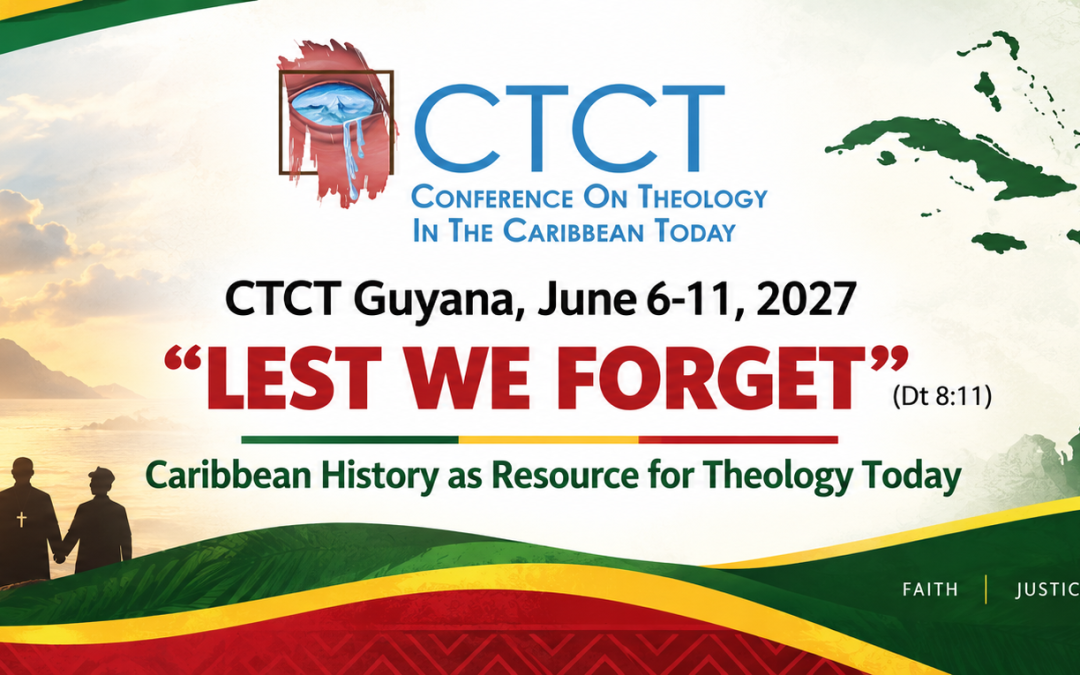
The Conference on Theology in the Caribbean Today (CTCT) is calling all Caribbean thinkers, activists, artists, laity, pastoral workers, academics, clergy, and theologians to reflect, prepare, and present on the theme: “Lest we Forget” – Caribbean History as Resource for Theology Today, at its 24th biennial theology conference, scheduled for June 6 to 11, 2027 in Guyana.
Collective History/Memory has always been fundamental to the way Christians have constructed their identity in relation to God. Starting from the people of Ancient Israel through to the early Christian community and beyond, scriptures, liturgical practices, and other performative rituals have been used to preserve and pass on collective memory. Prophets and theologians would turn to collective history at important junctures and crisis points in the development of the community. Deuteronomy 8 is foundational to this understanding of collective history, with writers urging their community not to forget God’s saving action while warning them of the consequences of this forgetting.
In this same vein, the CTCT locates this conference against the backdrop of current geopolitical and economic trends in the region and asks how the resources of Caribbean history can more explicitly contribute to theological thinking and transformative action in and for the region today.
At the same time, we are particularly mindful of how the colonizing project has purposely erased the histories of certain groups and how the oral traditions, aural practices, foodways, visual art, dance, and other forms of material culture and practices used to maintain collective histories experienced violent separation from their geographic homes. This has happened while championing European histories which themselves have been distorted because of issues of class, religion, and ethnicity.
The CTCT is reminded of the contributions of Guyanese thinkers such as Dale Bisnauth, Walter Rodney, Wilson Harris, David Dabydeen, and Shona Jackson who have all recognised the import and impact of history as a resource for imagining new histories for the region. Since its inception in 1994, the CTCT has interpreted theology in its broadest terms as the expression of persons of faith within a shared faith-community responding to the movements of the Spirit specifically within the Caribbean context. This has led to a transdisciplinary exercise of doing theology involving a diverse range of contributions over the years.
Contributions to this year’s theme are open to any aspect of theology and religion related to Caribbean history. These can include, but are not limited to:
- History of religions in the Caribbean
- Caribbean histories and their influence on religious and theological thinking / Theological and religious influences on historical changes in the Caribbean
- Re-telling stories of historical figures: pastoral workers & clergy, lay men & women, theologians, etc.
- Oral history as a source for theology for marginalised groups
- The preservation of collective memory through religion and/or the arts
- Caribbean church histories
- Any other related theme
Those wishing to present are invited to submit a brief abstract of no more than 200 words. These shall be submitted on or before March 5, 2027 to the CTCT Secretariat via email: ctctcfp@gmail.com. Please see the guidelines below.
Guidelines for Abstracts/Proposals to be submitted as a WORD document:
- Name of presenter(s) and contact details
- Title/Theme/Topic
- Format: Indicate intended presentation: e.g. poetry, movement, narrative/theological discourse, art, etc.
- State content/Idea covered and its significance for Caribbean theology, culture, life, pastoral action, activism, etc.
- Limit: 200 words
- Label WORD file – Abstract-Name eg. AbstractJohnT
Important Dates:
March 5, 2027 Abstracts/Proposals to be submitted.
April 24, 2027 Response/feedback to abstracts/proposals.
June 6-11, 2027 Conference
The CTCT is a group of Caribbean-based theologians broadly considered (including housewives, artists, historians, educators, social scientists, and religious professionals), who have been meeting biennially since 1994 to reflect in ecumenical and interfaith ways matters related to faith and culture within the Caribbean.